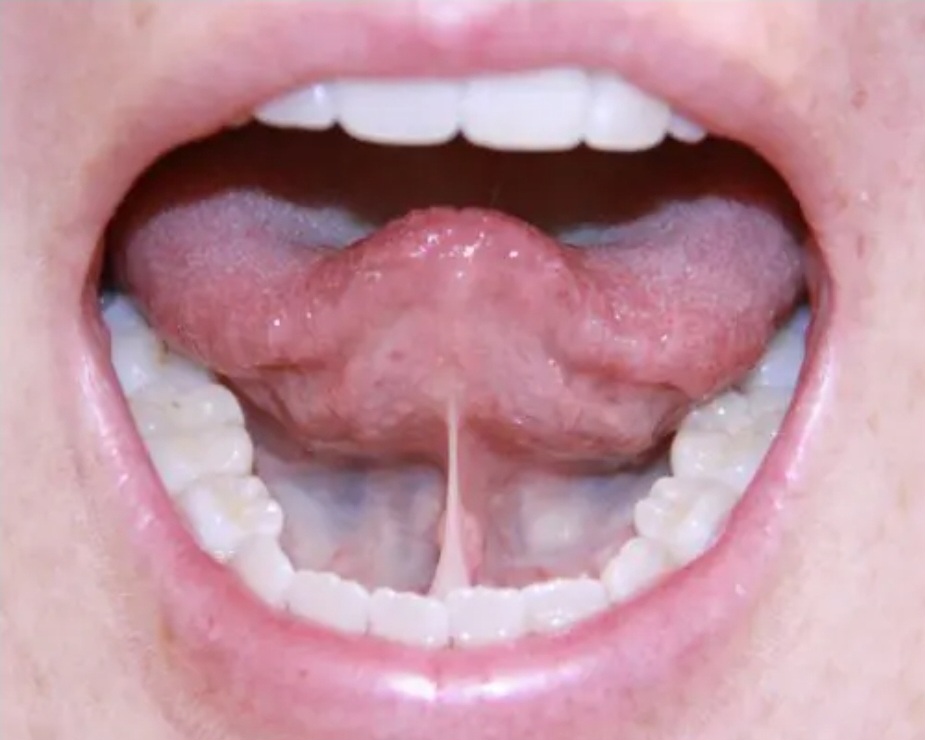
A tongue tie occurs when lingual frenum (or lingual frenulum), the band of tissue that stretches from under the tongue to the floor of the mouth is too short or too wide. When this occurs, it causes restriction and it affects the mobility of the tongue. A severely restricted tongue tie is often referred to as Ankyloglossia. There are different types of tongue ties and different levels of restriction that can cause problems in individuals of all ages.
Much more attention has been given to tongue ties in the last decade. Unfortunately, tongue-ties are probably the most underdiagnosed oral myofunctional disorder because the resulting consequences are often masked or go unnoticed.
Most medical and dental professionals are taught to look solely at the physical characteristics of the lingual frenum, without noting other factors influenced by the tongue-tie. It is often thought that if a person speaks clearly or has the ability to stick their tongue out past the lips, they are not tongue tied. This is not true. The tongue needs to be able to elevate across the roof of the mouth with light suction and without using the muscles of the neck and floor of the mouth. It must also be able to reach all the areas of the mouth to sweep away food, assist in swallowing, and speech. If the tongue has mobility in one direction it does not mean it has normal mobility in all.
A restricted lingual frenulum of the tongue limits the range of motion of the tongue and can adversely affect breathing, chewing, swallowing, the health of the teeth, teeth alignment, and speech.
In infants, a tongue tie may severely impede the ability to breastfeed successfully. Bottle feeding requires a completely different movement of the tongue that often leads to a high, narrow arched palate and a tongue thrust swallow. Common symptoms of tethered oral tissues in infants include:
In children, a tongue tie may lead to difficulties such as the inability to chew foods properly, gagging or choking, delayed speech development, crowding of the teeth, decay, and drooling. Common signs and symptoms include:
In adults, a tongue tie can interfere with the airway, crowded or misaligned teeth, and can be associated with issues such as sleep apnea, and strokes. Other problems include contributing to periodontal disease, gum recession, tooth mobility, and decay. Adults may experience:
A different type of tissue restriction is called a lip tie and is less common. This occurs when the frenum, or band of tissue, that connects the upper lip or lower lip to the gums, is too tight or too thick. This can cause spaces between the teeth and reduced ability to move the lips. It can also prevent a person from being able to completely close their mouth. If a baby has a lip tie, difficulties with feeding and digestion issues can also be a problem. A buccal tie, sometimes referred to as a cheek tie, refers to abnormally tight or short tissue stretching from the gums to the cheeks . This can also hinder feeding, food clearing, and can interfere with normal oral development.
Tethered oral tissues are commonly treated with a frenectomy. A frenectomy refers to the cutting of frenula tissue to release the tension and increase mobility. Other terms include “frenuloplasty,” “tongue-tie release,” “lip-tie release” and/or “buccal-tie release.” This procedure is most often performed by a specialized physician (e.g. neonatologist, ENT), dentist and/or dental surgeon. The procedure can be performed with a laser, scalpel, or scissors depending on the surgeon’s preference. Most commonly, the procedure can be done with topical or local anesthetic. Occasionally, general anesthesia will be recommended.
Every patient has an individual situation and the team involved in effective diagnosis and treatment is diverse. The decision to proceed with or without corrective procedures is a choice reserved for the patient and their family. Our job as myofunctional therapists is to educate patients, make necessary referrals and provide neuromuscular re-education intervention.